

From cells to forces: making the mechanics of life measurable
Mechanical forces play a crucial role in how cells behave, yet they are still rarely measured in a structured way. In this interview, Albert Konijnenberg explains how mechanobiology is becoming measurable, scalable and increasingly relevant for developing new therapies.
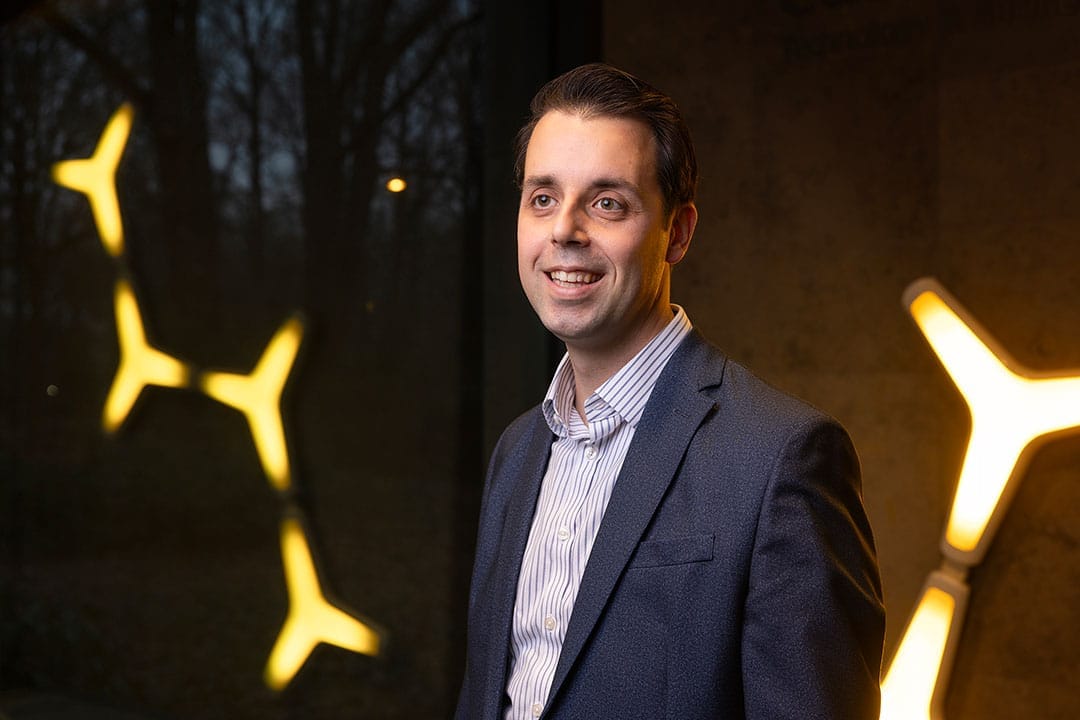
As Product Director at Optics11, Albert Konijnenberg helps translate advanced measurement technologies into practical tools for researchers working on cells, tissues and engineered living systems. In this conversation, he explains why the mechanical behaviour of cells is still rarely measured in a structured way, and how making these forces visible and scalable could change the way new therapies are developed.
Do you often have to explain at a Christmas dinner what you actually do?
“Sometimes, yes. And to be honest, explaining what mechanobiology is and why it matters can be quite a challenge.”
What is it about mechanobiology that excites you so much?
“What excites me most is that mechanobiology represents a largely underutilised biomarker. If you look at many diseases, such as asthma or fibrosis, we intuitively understand that stiffness and other physical properties of cells and tissues change and play a crucial role.
Yet these properties are rarely measured in a well-defined or standardised way. And certainly not at a throughput that makes it practical for pharmaceutical research. That gap is exactly why we moved into this space.
We are a technology-driven company. We use laser interferometry combined with fibre-optic sensing to quantify mechanical properties of cells and tissues in a way that is precise, reproducible and scalable.”
Laser interferometry sounds complex. Can you explain the principle behind it?
“At the heart of the system is a cantilever with a small probe. You can think of it as something like a tiny paper clip. We shine a laser on a reflective surface of that cantilever and analyse the phase shift of the reflected light.
That phase shift tells us how much the cantilever bends. And because we know the stiffness of the cantilever itself, we can calculate the exact forces involved. This allows us to measure mechanical properties very accurately.”
So you are literally pressing on cells?
“Yes, exactly. You can imagine my hand as the cantilever, with a laser shining on it. When I press down, the deformation causes a phase shift in the laser signal, and that is what we measure.
What is interesting is that we can do this not only with adherent cells, but also with cells in suspension, organoids and even liquid–liquid phase-separated droplets. In those cases, you might wonder whether you are measuring hydrodynamic effects or viscosity rather than stiffness.
By using very specific probes and being extremely careful in how we perform the measurements, we can still extract meaningful mechanical properties from those systems.”
You have developed several mechanobiology platforms. If I ask the unfair question: which one is your favourite?
“That is almost impossible to answer. But let me reframe it. One platform that really makes you step back is our muscle-on-chip system.
On a daily basis, we create three-dimensional functional muscle bundles that you can actually see with the naked eye. They respond to electrical stimulation and to drugs in a way that closely resembles what happens in the human body.
If you really zoom out, what is fascinating is that you sometimes start with a dish of undefined cells, even patient-derived cells, and end up with a functioning muscle tissue. That never really stops being impressive.”
Where do we see your technology being used in practice today?
“We serve a very diverse set of markets. In cosmetics, for example, we use nano-indentation to measure how products affect skin stiffness. This year, we saw the first publications from large cosmetics companies using our technology in product development.
We also work extensively with hydrogels. In contact lenses, for instance, swelling behaviour is critical to ensure comfort throughout the day and to prevent lenses from sticking.
In pharma, our muscle platforms are used to test drugs on three-dimensional muscle tissues. That allows researchers to study functional responses, not just biochemical markers.”
You are also involved in organ-on-chip research through NXTGEN Hightech. What does that involve?
“Within that programme, the focus is on building the infrastructure for scaling and standardising organ-on-chip workflows. In our case, that means integrating these systems into standard high-throughput laboratory environments.
We look at lab automation, robotic media exchange, fully automated casting of muscle bundles and, ultimately, scalability. One of the biggest challenges today is the number of cells required.
Creating a muscle bundle still takes around 600,000 cells, which is a lot, especially when working with patient-derived material. But we clearly see pathways to reduce that number by a factor of twenty.”
Looking ahead, what is your biggest challenge?
“Market reach. We are still a relatively small company with limited resources. Our biggest challenge is making people aware of what mechanobiology can offer and why measuring mechanical properties can add real value to biomedical research and development.”
And looking back at 2025, what are you most proud of?
“What a relatively small team can achieve. I come from a very large organisation, and seeing what 45 people can accomplish together is truly impressive.
We strongly believe in democratisation. Not just selling technology, but enabling our customers to actually build and use three-dimensional muscle models for skeletal, cardiac and smooth muscle. That helps move the entire field forward.”
About this series
This interview is part of a three-part series exploring where medtech and biomaterials converge. Recorded during a Medtech Special of the Great Small Talk Show, the conversations bring together different perspectives on how living cells, materials and medical technology are reshaping healthcare. Together, the series highlights not only technological advances, but also the practical challenges of translating them into scalable, reproducible and affordable therapies.
Also read:
