

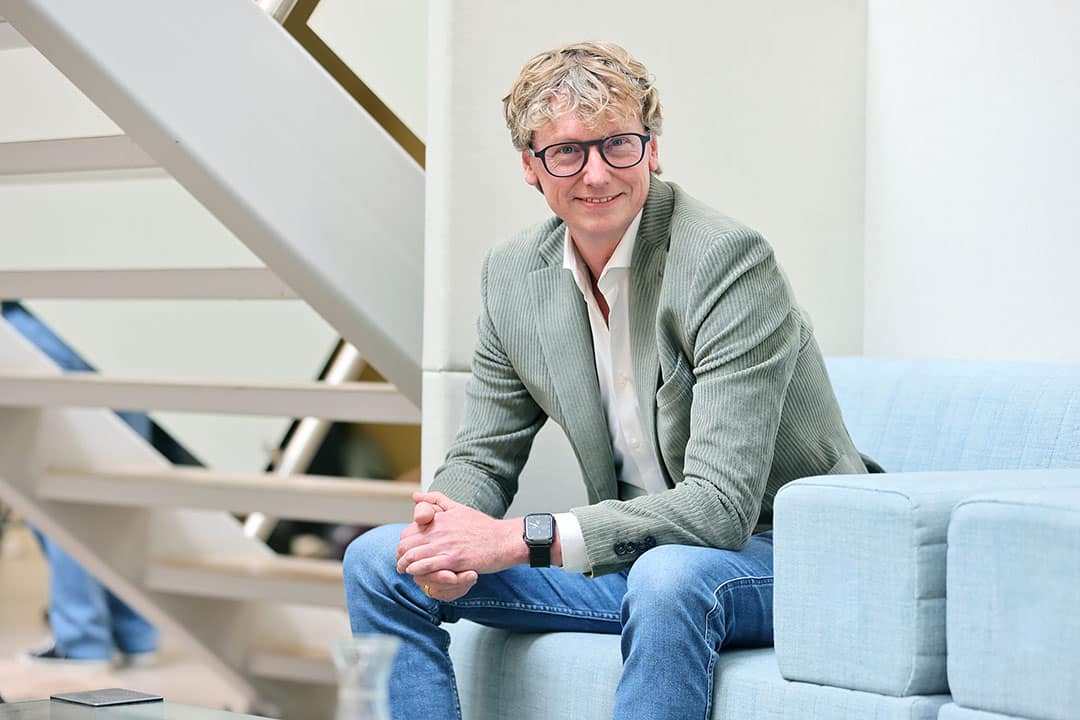
 Golo von Basum, Chief Operating Officer at STENTiT
Turning a medical technology into something that can safely be implanted in a patient requires much more than a successful laboratory result. For Golo von Basum, Chief Operating Officer at STENTiT, quality is not a hurdle to overcome at the end of development. It has to become part of the company from the beginning.
This is the first in a series of three interviews on the journey from lab to clinic, exploring what changes when promising medical technologies move towards clinical manufacturing.
STENTiT is developing a Resorbable Fibrillated Scaffold, or RFS, for patients with severely reduced blood flow below the knee. The scaffold is designed to restore blood flow and gradually resorb, while supporting the formation of new tissue. The company has already reached first-in-human clinical use and is now scaling manufacturing from an R&D environment towards controlled production.
You have moved from laboratory development towards products that can actually be implanted in patients. What changes at that point?
“The biggest change is consistency. You may be able to make something in the lab and test it preclinically, but implanting it in a real patient is a different matter.
You need to demonstrate that the process is controlled, that you can reproduce it and that you meet the regulatory requirements. That also means having a quality management system in place.
We are ISO 13485 certified, so we have a notified body assessing us. For a small and relatively young team, building a complete quality management system that is both compliant and still pragmatic is a substantial task.”
How much work does it take to establish such a quality system?
“It is definitely not something you do in a few weeks.
You need work instructions, operating procedures and training records, but the most important thing is that all of this becomes embedded in the daily work of the team.
If quality becomes an afterthought, or if it is treated as something only the quality department is responsible for, it will not work. It really needs to become part of the DNA of the company.
A startup actually has an advantage here. In a small team, you can build that mindset from the beginning and explain why certain procedures are necessary. You have the opportunity to make people understand not just what they need to do, but why they need to do it.
You only have one chance to build in the quality mindset from the start.”
Quality management can easily sound like procedures, checklists and documentation. Is that what it mainly is?
“Those things are certainly part of it. You need controlled processes, work instructions and documentation.
But the interesting part is the data you generate. That allows you to see how your process is evolving and how your product is performing. You can discuss with the team where improvements are possible and how the process can become better.
So it should not become an Excel checklist exercise. It is about understanding your control points and your data, because in the end you are producing something that will be implanted in a human being.”
Does that also change how you communicate quality within the team?
“Very much so. Making things visible helps, but explaining the reasoning behind them is even more important.
People need to understand why there is a checklist, why a work instruction exists or why something has to be documented. That makes a huge difference, especially when you have a team that is eager to learn and implement these ways of working.”
You have many years of experience at Philips. What has still surprised you in a startup environment?
“I underestimated how much effort it takes to manage not only your own organisation, but also the world around it.
Supplier quality management, supplier audits and the discussions with external partners all require significant attention. Making a medical product does not stop at the boundaries of your own company. Your suppliers and partners become part of the quality system as well.”
What has been the most important milestone for STENTiT so far?
“There are two things I am particularly proud of.
The first is reaching our first-in-human clinical trial. We took an idea from our founder, Bart Sanders, built the company around it and reached the point where the device could actually be implanted in a patient.
But I am equally proud of the team that has grown around it. Seeing people learn, develop and move step by step towards the level of maturity needed to manufacture this product is just as important.”
At what stage should a young medtech company bring quality expertise into the organisation?
“From the beginning. If you are building a medical device company, have somebody involved who can develop the quality management system, procedures and ways of working together with the rest of the team.
Don’t try to retrofit it later. Build it into the organisation from the start.”
Looking back, what part of the journey is easiest to underestimate?
“The amount of work involved in moving from we can make it to we can make it consistently.
Planning that transition, moving into a controlled environment and developing a controlled way of working all take time. It is important to allow enough time and to take the right steps at the right moment.”
What is the one piece of advice you would give another medtech startup?
“Don’t be afraid of quality. Embrace it, make it your own and build it in from the very beginning.”
STENTiT at SBMC
STENTiT is using the ISO 6 cleanrooms under GMP conditions of Smart BioMaterials Center to scale production of its Resorbable Fibrillated Scaffold from an R&D environment towards controlled manufacturing.
At SBMC, the company is working on a reproducible manufacturing process for clinical-grade production. As part of that transition, STENTiT is also integrating quality requirements, process control and supplier management into its manufacturing approach.