

For pioneering medtech companies, turning a promising laboratory concept into a clinically validated medical device requires more than breakthrough science. It also demands access to manufacturing infrastructure, quality systems and expertise.
That challenge is familiar to STENTIT, the Eindhoven-based company developing regenerative vascular implants that enable the body to create new blood vessels. As the company moves towards larger clinical studies and future market approval, manufacturing has become a strategic priority.
To support this next phase, STENTIT works closely with SBMC and its GMP-compliant cleanroom facilities in Eindhoven. This allows the company to scale production and avoiding the substantial investments required for a dedicated manufacturing facility.
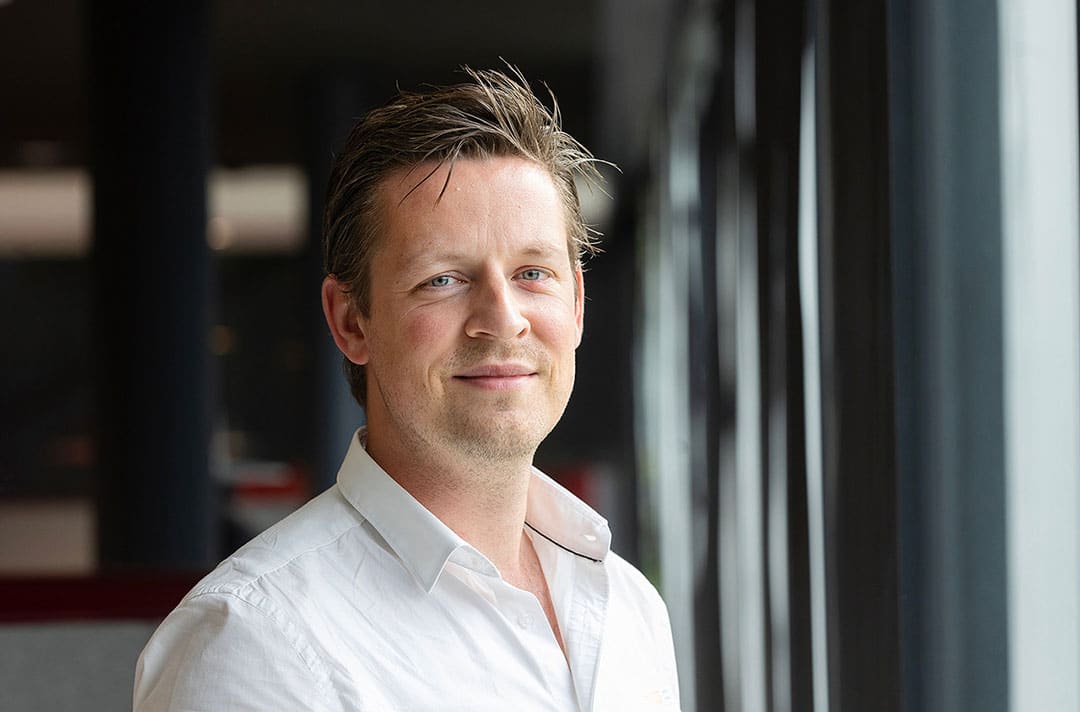
In this interview, CEO Bart Sanders discusses STENTIT's journey from academic research to entrepreneurship, the challenges of GMP manufacturing and the role of SBMC and the Brainport Eindhoven ecosystem in bringing regenerative implants closer to patients.
From academic breakthrough to medtech startup
STENTiT develops regenerative vascular implants. When did you first realise: this has to reach patients, this technology can genuinely change lives?
“ STENTIT emerged from pioneering research at the Biomedical Engineering Department from the Eindhoven University of Technology focused on harnessing the body’s own natural regenerative capacity. By using a fibrous implant as a temporary scaffold, the body was triggered to create its own cardiovascular tissue. Building on these insights, we translated the technology into a regenerative stent platform, giving rise to STENTIT.
From the beginning, our goal was clear: translate academic research into a product that improves patients’ lives. We started with a promising technology, but turning it into a successful medical innovation required identifying a clinical need where it could make a meaningful difference. That meant looking beyond the science to understand where our regenerative approach could offer clear advantages over existing treatments and deliver tangible benefits for patients.
Through persistence, we turned a promising research concept into a company.”
"When people say something cannot be done, I feel an even stronger desire to demonstrate that it can."
What did you personally have to learn when transitioning from researcher to entrepreneur?
"It was actually a very gradual process. When you're in the middle of it, it doesn't feel like a dramatic shift. But looking back, the things I do today are completely different from what I was originally trained to do.
Initially, I worked in the laboratory myself. I conducted research and developed the technology. Then you start hiring people, transferring knowledge and building a team. Gradually, your focus shifts from the technology to the company.
Suddenly you find yourself dealing with HR, contracts, legal matters, financing and strategy. As the company expands, you naturally grow into that role absorbing these responsibilities.
It has been an excellent learning experience. You learn how to grow a team, rais funds, build collaborations, make decisions and develop confidence.
In the beginning, many people saw only a young researcher with limited experience. You were often underestimated. People would say: first prove that it works. Sometimes they dismissed the idea quite readily.
I always handled that fairly well. In fact, it tends to motivate me. When people say something cannot be done, I feel an even stronger desire to demonstrate that it can.
As the company grows and results become visible, perceptions change. People begin to see that there is something tangible behind the vision."
Building a scalable pathway to clinical adoption
Where does STENTIT currently stand in its development trajectory?
When I look at the company’s development, I see a few clear phases. The first was knowledge transfer. It was important that the expertise did not stay with just one person. We needed to build a team and make sure the company could move forward independently. I believe we have reached that point.
The next phase was further developing the prototype and then standardising it. That meant putting documentation, a quality management system and clear processes in place. A huge and nessecary step moving towards initial manufacturing, greatly being managed by my colleague Golo.
That was a real shift for the team. Most of the people hired had a strong research background needed to build the protoype, but less as a manufacturing specialists, so suddenly they had to think about reproducibility and standardisation. But they adapted very well, which made me feel super proud on the team.
Now the focus is on batch production with detailed focus on all parts of the proces, which is essential if you want to reach the clinic.
We have already completed a feasibility study in six patients with below-the-knee arterial disease, following extensive preclinical work. The key question was whether the implant would initially be safe and perform as intended in people. That is exactly what we set out to show, with promissing results.
Why GMP manufacturing is critical for regenerative implants
STENTIT collaborates with Smart BioMaterials Center in the GMP cleanrooms. What activities take place there today?
"We have now demonstrated early feasibility that our fibrous vascular scaffolds perform as intended. The next step is scaling up.
Future trials will involve significantly larger patient populations. Here, we have to demonstrate not only safety, but also efficacy. To achieve that, manufacturing must scale accordingly.
For the first study, production could remain relatively small. We had one size only of the implant and a limited number of patients. Today we have multiple implant sizes and we are preparing for studies involving several hospitals.
Before launching a clinical study, we also need large numbers of implants for verification and validation testing. Those implants all need to be manufactured in tighly controlled cleanrooms to be used for instance for mechanical, toxicological and usability testing before patient batches can be released.
Only after all those activities have been completed successfully can we manufacture the implants intended for patients.
The simple reality is that we need to manufacture much more than before. That is exactly the phase we are in today."
Why did you choose SBMC's cleanroom facilities rather than outsourcing to a contract manufacturing organisation or building your own GMP facility?
"Our manufacturing process is highly unique. It is not comparable to a conventional metal stent that can be produced in many different locations. Producing our fibrous structures involves specialised knowledge and expertise that has been build up and maintained solely within our company.
As a result, this knowhow is now an important key asset to the company.
Building our own GMP facility would certainly be possible. However, you would need to invest millions before even obtaining an empty cleanroom.
Capital is scarce for companies in our sector. Significant funding only becomes available once major clinical risks have been reduced, while reaching that point does require substantial investment. You therefore want to direct your available resources towards product development and clinical studies.
Spending millions on infrastructure immediately shortens your runway. And in our industry, cash is king. Value is created through clinical data, not by owning a building.
If there is already a facility available that you can use, and if it is ultimately more cost-effective than building your own, the decision becomes straightforward. That was the primary reason for choosing SBMC."
Many young medtech and biomaterials companies discover that GMP is a major challenge. What obstacles did STENTIT encounter when manufacturing processes had to become reproducible and compliant?
“One of the biggest challenges was transitioning from a flexible R&D environment to a GMP-compliant manufacturing process. To achieve reproducible production, we first had to standardize and document all processes within a robust Quality Management System (QMS), ensuring that all procedures, records, and documentation were accessible and traceable.
Another key challenge was implementing quality controls throughout the entire production chain. We introduced multiple in-process quality checks to monitor critical parameters, detect deviations early, and maintain consistent product quality from raw materials to the final product.
This transition required a more structured way of working, with clear procedures, open communication, controlled environments and stricter adherence to protocols. At the same time, as a startup, it was important to remain agile, pragmatic, and solution-oriented.
Perhaps the most important aspect was creating a culture of quality. Achieving full traceability is not only about building robust systems; it also requires the entire team to embrace the mindset and discipline needed to work consistently within a GMP framework.”
Brainport Eindhoven and the future of regenerative cardiovascular care
Brainport Eindhoven increasingly positions itself as a leading ecosystem for biomaterials and regenerative medicine. How important has that environment been for STENTIT?
“Brainport for us is extremely important. It has built a strong biomaterials ecosystem over many years, with TU/e, companies like Vivolta, Xeltis, Vivart-X, all contributing to that. But also to test new implants there is a good support network from companies such as LifeTec Group, PTG and Sure Laboratrototies.
It creates a catalysing effect: success attracts more companies, investors and new ideas. We see that directly in the infrastructure around us, including facilities like SBMC and TWICE and the wider regional support system. Also MedTech in general is growing in the region based on the staggering growing number of companies here at HighTech Campus. For a company like ours, I do not think there is a better place in the Netherlands. “
Looking five years ahead, where do you hope STENTIT will be?
"In five years, we want a have commercial first product available here in Europe, actively used to treat patients with peripheral arterial disease.
Meanwhile, we are building a strong pipeline of associated products for many other clinical indications. This device and its underlying technology holds a big promisse and potential.
Today, patients almost always receive a permanent implant. We believe regenerative devices can ultimately be used in many more indications, like opening up other occluded vessels, or reinforcing dilated aneurysms, for indications from up in the brain to down in the foot and all in between
If we can demonstrate success in one indication, this will open doors to many others.
And personally? I am a proud person surrounded by a fantastic team. I truly enjoy to see every step we take to grow the company to the next level. In our world, 5 years is a relative short horizon, but with all our ambition, this must become the new standard for cardiovascular interventions.
It is hard work, but at the same time, also incredibly exciting!"
STENTiT and SBMC work together in StentUp, a project that explores a different path using SBMC’s state-of-the-art GMP cleanrooms on the High Tech Campus Eindhoven to develop regenerative stents that help blood vessels repair themselves.